Morristown Memorial Hospital
The Good Nurse: A True Story of Medicine, Madness, and MurderMorristown Memorial Hospital was the New Jersey hospital where Charles Cullen worked after leaving Hunterdon in October 1996, and where a series of documented performance and safety concerns ended in his dismissal less than a year later. Its significance in the narrative lies not in any confirmed finding that Cullen killed patients there, but in the widening gap between the hospital’s repeated warnings about his practice and the uncertainty that remained afterward: Cullen later thought he might have been involved in one or two deaths, yet investigators could not identify victims among the hospital’s patient records.
Hiring and Setting
After resigning from Hunterdon, Cullen drove directly to Morristown Memorial Hospital to apply for a job. The hospital’s human-resources department had a professional service vet his background, and the review found several discrepancies in the dates he gave for earlier employment. Morristown hired him despite those inconsistencies. He had nine years of nursing experience at Hunterdon, Warren Hospital, and Saint Barnabas, and the hospital needed staff to cover shifts.
Cullen’s schedule was demanding: seventy-five hours a week, with additional shifts when he could get them. He earned $23.27 an hour and worked from seven at night until seven in the morning on the Cardiac Care Unit. The account describes him as still reeling when he arrived and as failing to provide some of his better nursing work. The night-shift setting matters to the record of his employment: morning staff encountered the results of his care and documented concerns that had accumulated while he was responsible for patients overnight.
Complaints and Patient-Safety Concerns
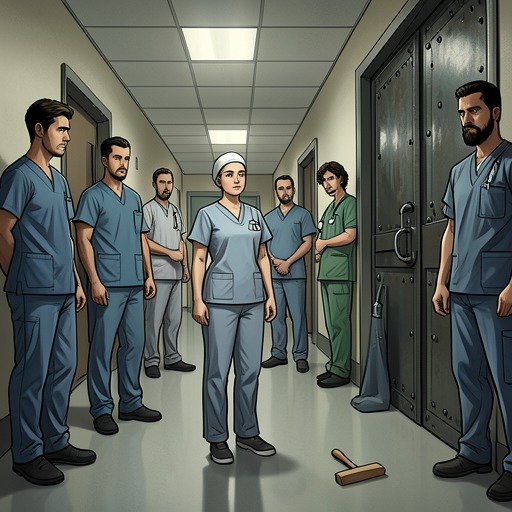
The morning nurses found patients in pools of their own blood, a sink containing twenty-five washcloths, and clutter left on the counter. They recorded the conditions in patient-incident reports. Cullen regarded the reports as petty, particularly their attention to the washcloths, rather than as evidence of a recurring problem with his care. One patient told Cullen’s supervisor that he wanted to call the police. No call was made; Cullen instead received a lecture. The book presents this as one element in a growing pattern of scrutiny, including medication incidents.
Cullen appeared careless on several occasions when administering Diprivan or heparin, loading patients with the wrong dose. Complaints were not limited to staff observations: patients were also voicing dissatisfaction. A handwritten note found among employment-related paperwork described one patient as only one of many who had expressed the same concern, and stressed the patient’s safety as well as the unit’s reputation. The incidents accumulated until Morristown’s superiors concluded they could not be ignored.
The most consequential episode involved an unnamed male patient scheduled for surgery the following morning. The patient had been prescribed regular heparin, which Cullen, as his nurse, was supposed to administer. He did not give it, and the patient died. The physician on call was furious, and Cullen told the doctor and others afterward that the omission had been accidental. The narrative carefully distinguishes the death from a proven causal finding: Cullen’s mistake and the patient’s death were never explicitly linked. The potential danger was nevertheless apparent to hospital leaders.
Administrative director Lisa Gannon called Cullen’s actions inexcusable, and Dr. John Banas, chief of the Department of Cardiovascular Medicine, supported her concerns. Gannon wrote that she doubted Cullen’s competence and ability to provide safe care. He was assigned harmless busywork for the remainder of his shift and then sent home for a week. Cullen felt wronged, but initially did not confront his superiors directly. In the account, the hospital’s response follows a series of patient complaints and practice concerns; it is not presented as a finding that he had deliberately caused a death.
Dismissal and Dispute
When Gannon’s secretary called to arrange a meeting, Cullen refused to come in and said they could dismiss him by telephone. He then ignored Gannon’s calls and messages. On August 13, she was still asking him to come in and speak with the hospital. The following day, she sent a certified letter demanding his identification badge and other hospital property and informing him that his employment had ended effective immediately. A few days later, Cullen returned early for what would ordinarily have been his Saturday-night shift and saw his name crossed off the shift whiteboard.
The dismissal was formally attributed to poor performance and nurse-practice issues, rather than to killing patients. Cullen himself believed he might have killed one or two people at Morristown, but at the time could not name them or give specifics. In his later account to detectives, he said he could have been involved in something there. He supplied no further details, and the subsequent investigation did not identify victims among Morristown’s patient records. That unresolved suspicion should not be confused with a confirmed case or with the reasons the hospital gave for terminating him.
Review, Arbitration, and Unresolved Record
After losing his job, Cullen sought a review of his case. He wrote to hospital director Kathleen C. Chumer, first by hand and then in a typed letter, asking for his termination to be reconsidered. The Hospital Review Board and the director each concluded that the dismissal had been appropriate. Cullen then demanded outside arbitration, and lawyers for Morristown and the American Arbitration Association exchanged letters in preparation for a formal review.
The process did not give Cullen the result he wanted. After he had been away from the dispute for months, he learned that the review had been forfeited because he had not paid his share of the arbitration fees; his testimony later put the amount at $500. He replied that he had been in a mental institution and had no employee handbook, so the delay was not his fault. In March, he threatened to sue unless the hospital granted an extension. Morristown sent him another employee handbook by certified mail and granted the extension, but Cullen never wrote back. The matter that had once seemed urgent to him simply lapsed.
Morristown Memorial Hospital’s place in the narrative is therefore defined by both the specificity of its warnings and the limits of what was established. Staff documented disorder, patient complaints, apparent medication errors, and a grave failure to administer prescribed heparin; administrators removed Cullen from patient care and dismissed him. Yet neither the hospital’s stated rationale nor the later record established that he had murdered anyone there. The employment file preserves a troubled period of patient care and a contested termination, while the possibility Cullen himself raised remained unsubstantiated.